

For the Manufacturing Engineer, leak detection is the intersection where production efficiency meets facility safety.
As the industry standardizes on next-generation refrigerants—specifically A2L (mildly flammable) and A3 (highly flammable) classes—leak detection strategies have shifted from quality control checkpoints to critical facility infrastructure.
Here is how Airserco supports the modern manufacturing line.
1. Process-Level Detection: Quantitative Accuracy
In high-volume production, the goal is to identify defects as early as possible to avoid the “Value-Added Waste” of charging a leaking unit. A robust line utilizes a tiered testing strategy.
Tier 1: Vacuum Decay (The “Dry” Test)
Before refrigerant ever enters the circuit, the evacuation station is your first line of defense against gross leaks and moisture.
- The Metric: Using the 8900VG Digital Vacuum Gauge, the system performs a Rate-of-Rise test.
- The Process: After reaching the target vacuum (e.g., 50-100 Microns), the valve isolates the pump. If the pressure rises faster than the calculated curve for the internal volume, the system identifies a leak or excessive moisture (outgassing).
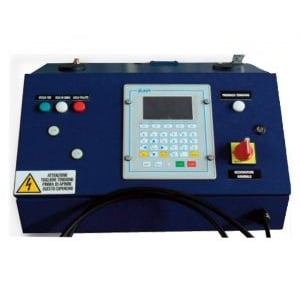
- The Control: Automated stations like the APC-2 Vacuum System will interlock the process, preventing the charging valve from opening on a failed unit.
Tier 2: High-Pressure Tracer Gas (The “Fine” Test)
Vacuum decay is excellent for moisture and gross leaks, but for micro-leaks (down to $1 \times 10^{-5}$ atm·cc/s), positive pressure tracer gas is required.
- Methodology: The iAmiata Station charges the unit with a tracer gas mixture (typically 95% Nitrogen / 5% Hydrogen) at pressures exceeding operational norms.
- Detection: Because Hydrogen molecules are significantly smaller than refrigerant molecules, they permeate micro-fractures that refrigerant might not initially leak through.
- Application: This allows for robotic sniffing or accumulation chamber testing to certify the unit is leak-free before the final refrigerant charge.
2. Facility Safety: The “Red Zone” Infrastructure
With the adoption of R-454B (A2L) and R-290 (A3), the charging area is often classified as a hazardous “Red Zone.” Leak detection here is not just about product quality; it is about life safety and compliance with global safety standards.
The Medusa Safety Ecosystem
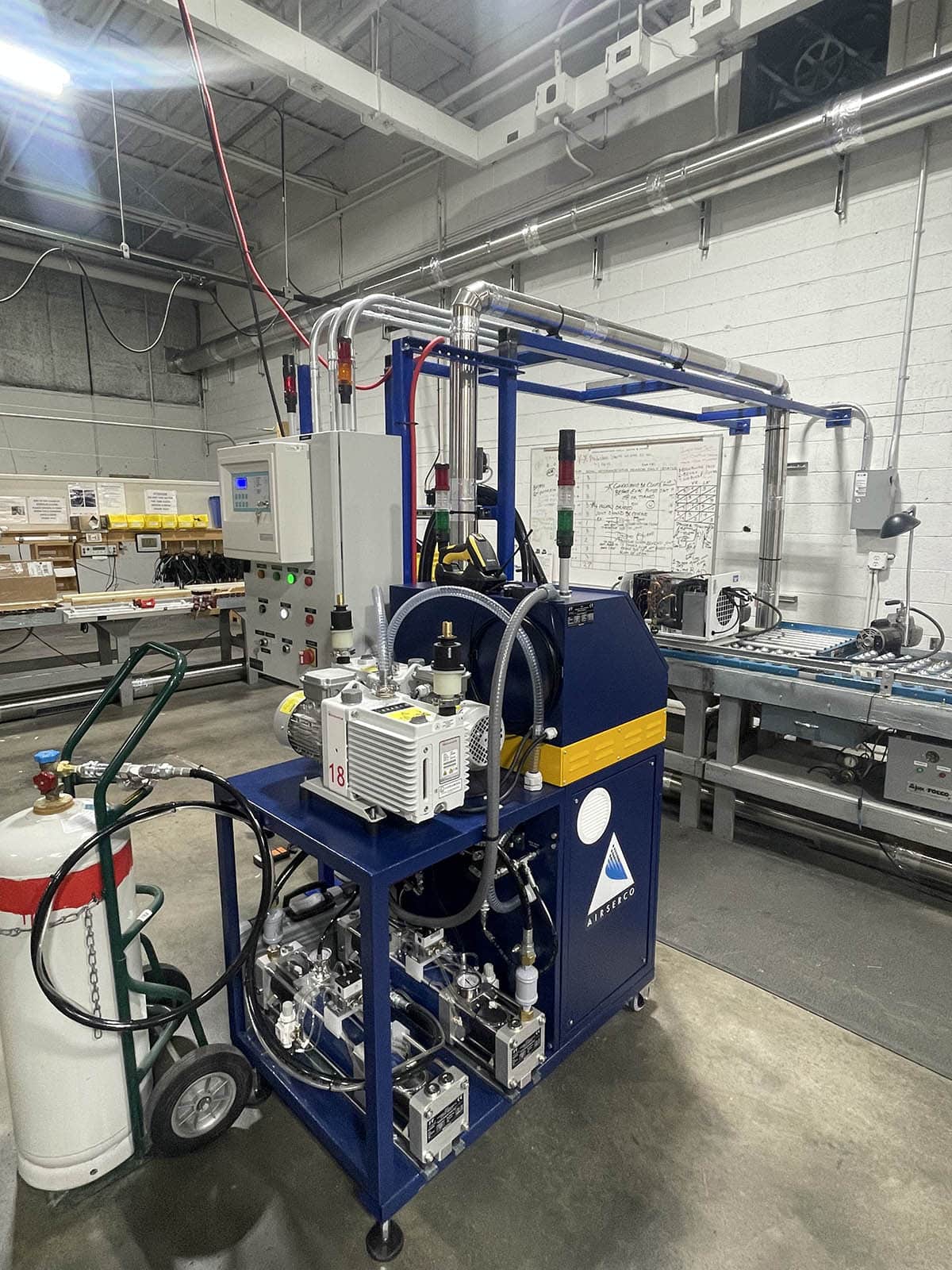
Airserco’s Medusa Safety Controller functions as the active safety logic for the charging line. It moves beyond simple “detection” into Active Mitigation.
- Technology (NDIR): We utilize Non-Dispersive Infrared (NDIR) sensors. Unlike semiconductor sensors, NDIR sensors are gas-specific and immune to “poisoning” from common plant chemicals like braking flux or cleaning solvents, which prevents nuisance trips.
- Mitigation Sequence: The Medusa is programmed to trigger at specific Lower Flammability Limit (LFL) thresholds. Upon detection, the hard-wired logic executes:
- Supply Cut-off: Pneumatic valves on the refrigerant supply line instantly close.
- Ventilation Surge: Exhaust fans toggle to high-speed extraction to dilute the gas pocket.
- Process Interlock: The A2L Charging System is disabled, and the station enters a locked state until the area is cleared.
3. System Comparison for Selection
To assist in the specification process, the following table compares the primary leak detection technologies used in a modern HVAC manufacturing facility:
| System | Primary Function | Measurement Type | Typical Stage |
| APC-2 Vacuum System | Evacuation & Rise Test | Vacuum (Microns) | Pre-Charge (Internal) |
| iAmiata Station | High-Pressure Leak Test | Tracer Gas (PPM) | Proof-Testing (Internal) |
| Medusa Controller | Facility Safety | Gas Concentration (% LFL) | Production Area (External) |
| 8900VG Gauge | Verification/Calibration | Absolute Vacuum | Quality Lab / Maintenance |
4. Data Integrity & ISO Traceability
Modern Manufacturing Execution Systems (MES) require data, not just green lights. The ROI of an integrated Airserco system is found in its traceability.
- The “Birth Certificate”: Every unit produced generates a data log containing its initial vacuum level, leak rate-of-rise results, and final charge weight. This data is tied to the Serial Number, providing irrefutable proof of process integrity.
- Audit Readiness: Automated logging ensures your facility is always ready for ISO 9001 audits or regulatory inspections regarding refrigerant management and EPA AIM Act compliance.
Conclusion: Engineered for the Future of Cooling
As manufacturing tolerances tighten and refrigerant flammability becomes a standard variable in facility design, your detection equipment must be as robust as your assembly line.
Whether you are retrofitting an existing line for A2L compliance or designing a greenfield facility, Airserco provides the engineering expertise—from vacuum gauges to safety interlocks—to keep your line running safely and efficiently.
Don’t let leak detection be the bottleneck. Contact our engineers for your next steps.