A2L Refrigerant Charging Systems for Data Center HVAC Manufacturing
April 15, 2026 Airserco Academy
Engineering a Compliant, High-Volume Production Line
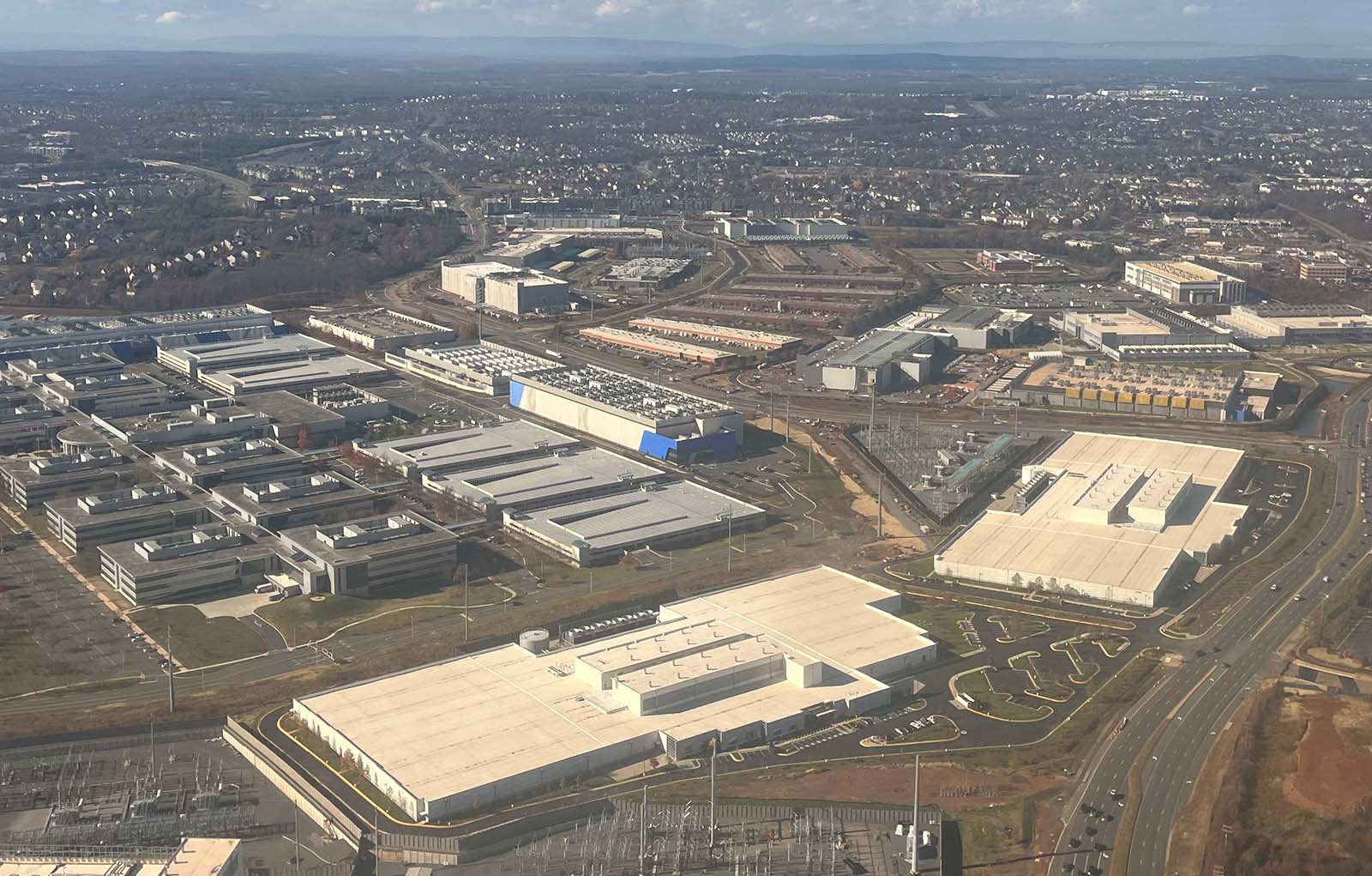
Data center OEMs building CRAC/CRAH units, precision air handlers, and high-capacity chillers are dealing with two things at once in 2026: fast growth in AI-driven cooling demand and the EPA’s Technology Transitions Rule under the AIM Act.
DOE has also noted that U.S. data center load growth has tripled over the past decade and is projected to double or triple again by 2028.
Data Center Construction
For data centers, computer room air conditioning, and information technology equipment cooling, the EPA rule sets a GWP limit of 700. New systems using refrigerants above that threshold may still be installed through January 1, 2027, as long as all components were manufactured or imported before January 1, 2026. Source | EPA sector restrictions
That creates a real planning constraint for manufacturing teams. A2L refrigerants – including R-454B, R-32, R-1234ze, and R-1234yf – are usually best accounted for early in facility and line design, often before groundbreaking, so charging stations can be planned around ASHRAE 15, refrigerant safety classification, applicable UL refrigerant safety requirements, and local fire and building code expectations from the start.
Regulatory and Production Context for Data Center Cooling OEMs
Data center cooling equipment often carries larger refrigerant charges and tighter performance tolerances than lighter commercial equipment because efficiency and uptime requirements leave less room for charging variation. At the same time, hyperscale production targets push throughput into units-per-shift territory, not units per day. Add mildly flammable A2L refrigerants into that environment, and charging becomes a facility-design issue, not just a process step. ASHRAE Standard 34 is the baseline reference for refrigerant safety classification, including the A2L category.
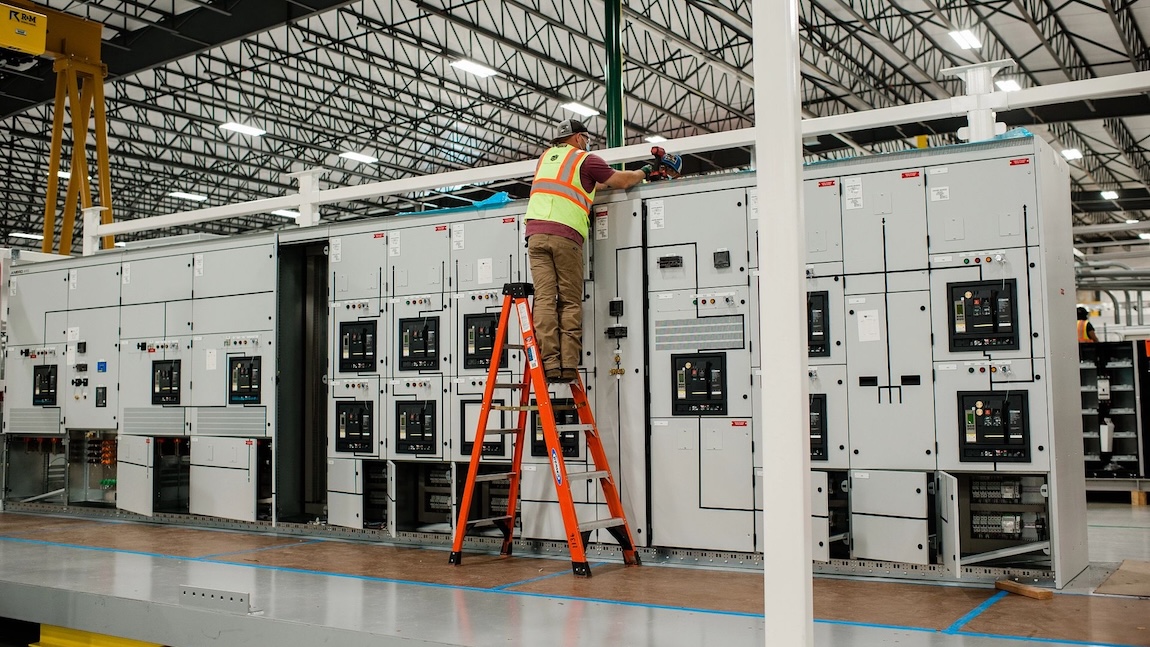
ASHRAE 15 addresses refrigerant concentration limits, ventilation, and leak detection for installed refrigeration systems. UL 60335-2-40 adds requirements related to refrigerant leak detection, charge limits tied to occupied volume, and mitigation of ignition risk in applicable equipment. In a manufacturing environment, those same principles still drive the charging-area design: safe handling, detection, ventilation response, and integration with the broader facility safety approach. Engineers who define those requirements early can build them into MEP layouts, electrical zoning, and area safeguards instead of trying to retrofit them later.
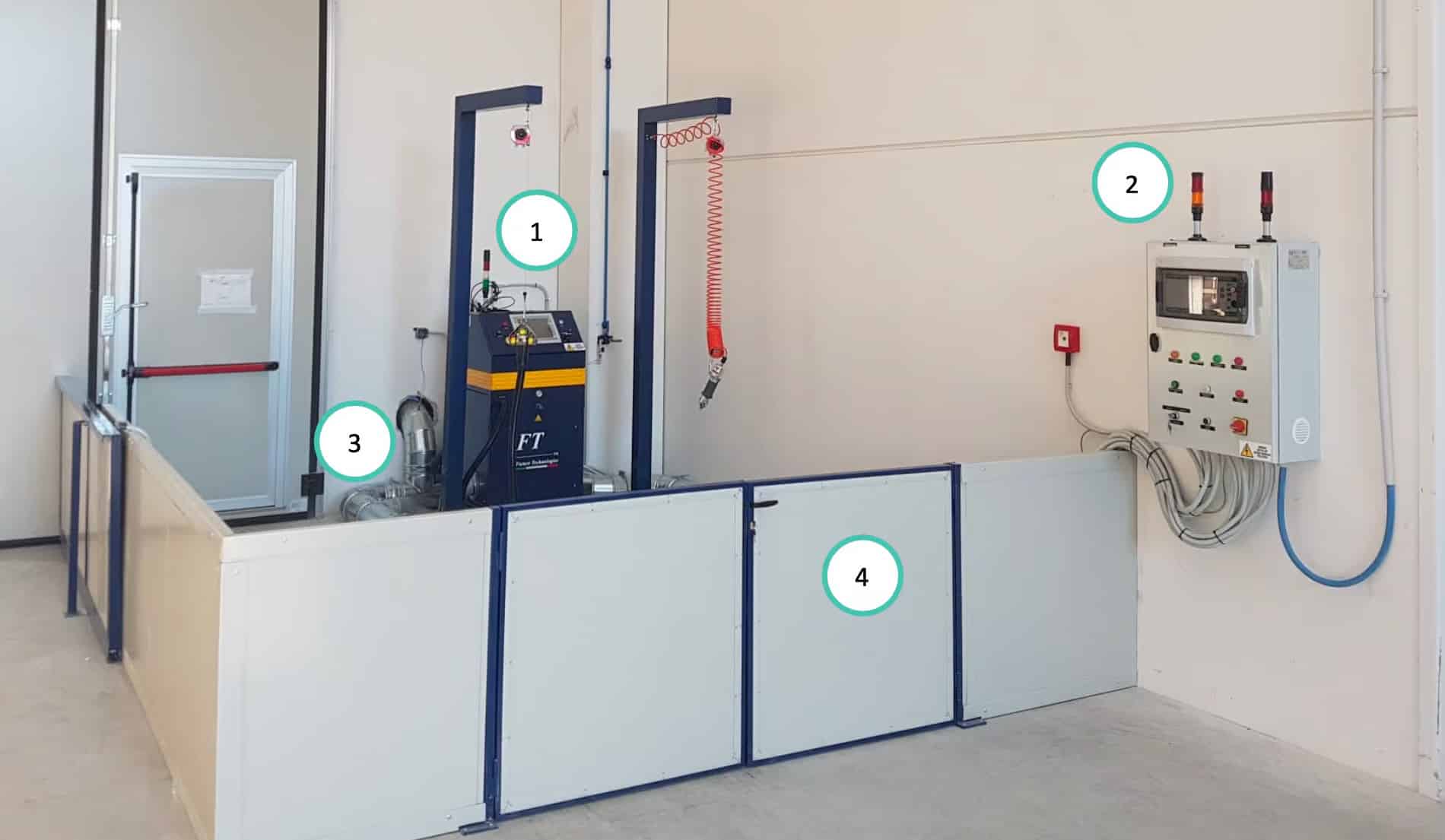
Example Drawing of Compliant A2L Charging System
Key Engineering Challenges in the A2L Transition
Manufacturing teams evaluating A2L charging for data center lines usually run into the same set of issues:
Flammability management at scale – A2L refrigerants require layouts and components that reduce ignition risk and support fast leak response in high-throughput environments.
Evacuation and vacuum performance – Large-charge systems need repeatable deep vacuum levels, often around 500 microns or better, without contamination or cycle-time drag.
Charging accuracy and data integrity – Tight charging control matters for unit performance, refrigerant usage, and traceability. Manual processes usually make audit-ready records harder to maintain.
Safety-system integration – Charging stations generally need to tie into facility ventilation, leak sensing, and area monitoring to align with the expected safety design.
Throughput scalability – A single-station pilot setup may prove the concept, but it often does not survive contact with real production volumes.
Those issues show up quickly in cycle time, refrigerant cost per unit, first-pass yield, and inspection readiness.
Core Engineering Requirements for A2L Charging Stations
A production-ready A2L charging system should function as a safety-engineered production cell with integrated controls, monitoring, and traceability. In practice, that usually means the following:
Charge accuracy and throughput – Accuracy has to be tight enough to support unit performance while keeping pace with takt time. For example, Airserco’s published system overview lists ±1 g accuracy for charges under 200 g, ±1% for larger charges, and charging speeds up to 25 g/s for some configurations.
Integrated vacuum capability – Pumps need to be sized for the application, with controlled sequences for evacuation, pressure testing, and rise/decay monitoring.
Programmable automation – Multiple stored work cycles and data logging are important for repeatability, quality reporting, and traceability.
Hazard-mitigation features – Spark-free motors, sealed electrical systems, and designs matched to the applicable safety and code framework matter here.
Environmental monitoring – Leak detection and safety controls need to support real-time response and ventilation tie-ins.
Line compatibility – The charging system has to work with the rest of the line, whether that means a single station, a multi-station cell, or conveyor integration with optional pressure testing or oil injection.
Example of an A2L System Installation
iRockall HC ( Vacuum and flammable refrigerant charging system)
Medusa ( Safety Monitoring and Mitigation Controller)
Air ducts for Eolo (Variable Speed Extraction system with DPS feedback)
Non flammable panels (and door sensors)
Example of an A2L System Setup
Some OEMs also look at A3 refrigerant systems to preserve flexibility as refrigerant portfolios evolve, though those applications generally come with additional hazard controls because of the higher flammability involved. Related UL overview
Best Practices for Pre-Construction Integration
The projects that go more smoothly usually do a few things early:
Document unit parameters early – charge volumes, target cycle times, and conveyor layout all need to be known early enough to size and zone the charging area properly.
Coordinate with MEP design – power, ventilation, controls, and safety requirements need to reach the architect and trades before drawings are locked.
Ask for charging-area guidance, not just equipment – leak-detection layout, ventilation approach, safety barriers, and operator protocols should be part of the discussion.
Validate scalability before rollout – it is easier to prove cycle performance and data logging on one station before scaling to four.
Design for operational continuity – the less manual intervention required during charging, the easier it is to maintain repeatability under real production pressure.
For example, if an OEM is planning a four-station A2L charging setup for 80-150 lb charges with a sub-15-minute target cycle per station, those assumptions need to be reflected in plant layout, ventilation, electrical zoning, and controls logic early. Otherwise, the charging system becomes the thing the whole project has to work around later.
Purpose-Built A2L Refrigerant Charging Systems
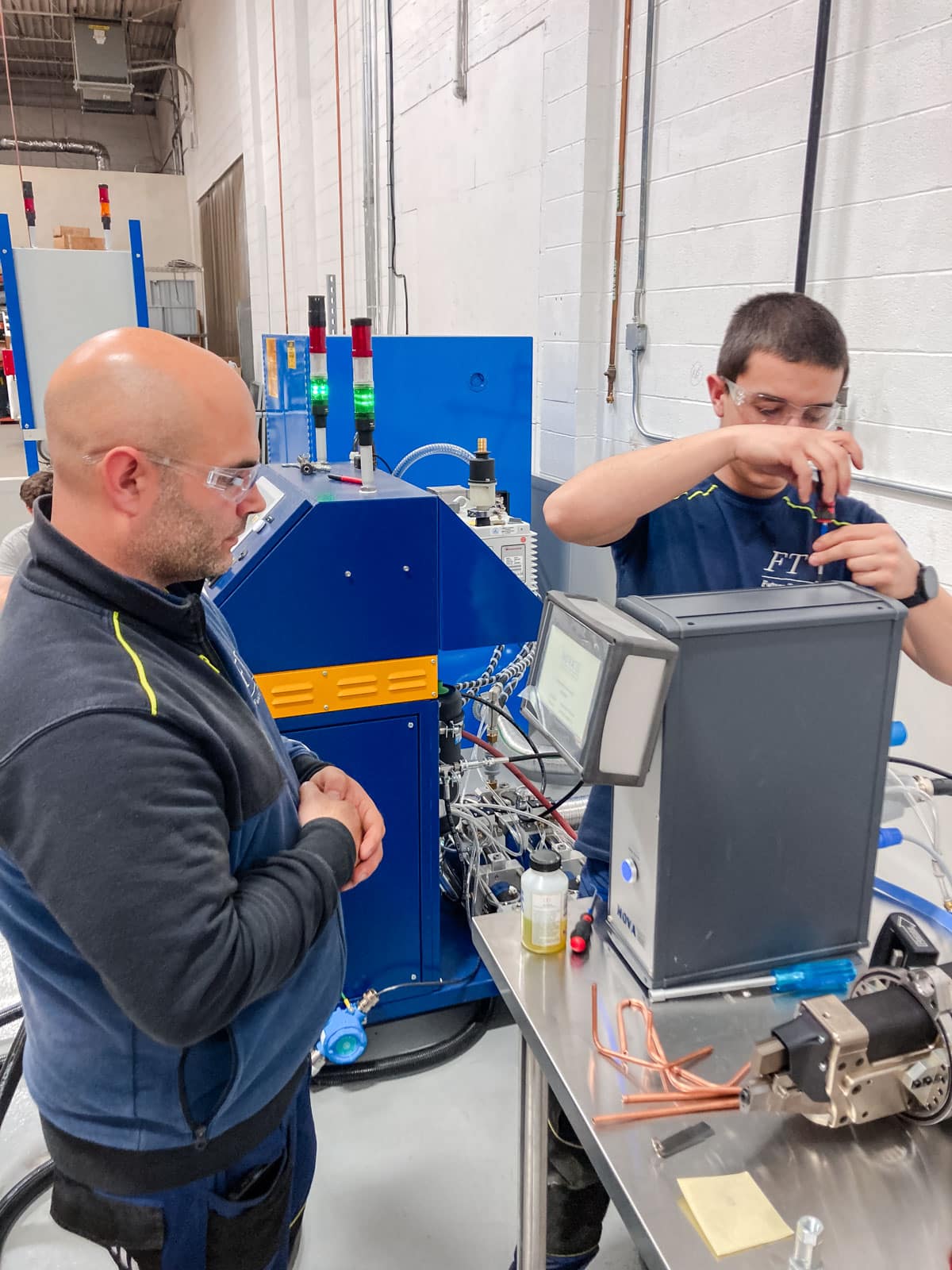
Airserco’s A2L Refrigerant Charging Systems are configured for HVAC OEMs making this transition. Our systems can include built-in vacuum pumps rated at 20.5 m³/h or larger, programmable cycles with TCP/IP data collection, and integrated safety monitoring such as Medusa Safety Controllers and infrared leak sensing with automated response. Depending on project scope, delivery can also include safety-area documentation, ventilation coordination, and commissioning support.
For manufacturing engineers still shaping facility plans, the charging station is not something to leave until the end. If it is specified early, it can help prevent downstream rework in ventilation, controls, safety zoning, and line throughput planning. If it is specified late, it tends to become one of the more expensive things to fix.
Safer, Faster, and Compliant HVACR Manufacturing
Trusted Equipment, Expert Installation, and Ongoing Support