
Table of Contents
Why High-Vacuum Sealant?
In high-vacuum manufacturing and laboratory environments—whether you are evacuating refrigeration circuits or processing semiconductors time is the most expensive variable.
The scenario is all too familiar: Your high-capacity pumps are running, the manifold is optimized, and conductance is maximized, yet the vacuum gauge stalls. It hovers just above your target micron level, refusing to drop. You are likely facing a micro-leak or a “virtual leak” (outgassing), and in a production environment, you do not always have the luxury of a full tear-down to re-tape every thread or re-flare every connection.
For the Manufacturing Engineer responsible for process efficiency and throughput, the solution often requires a chemical bridge—a sealant capable of withstanding high-vacuum stress without becoming a permanent contaminant. This article explores the role of LiquiVac as a strategic tool for rapid vacuum remediation.
The Physics of the Stall
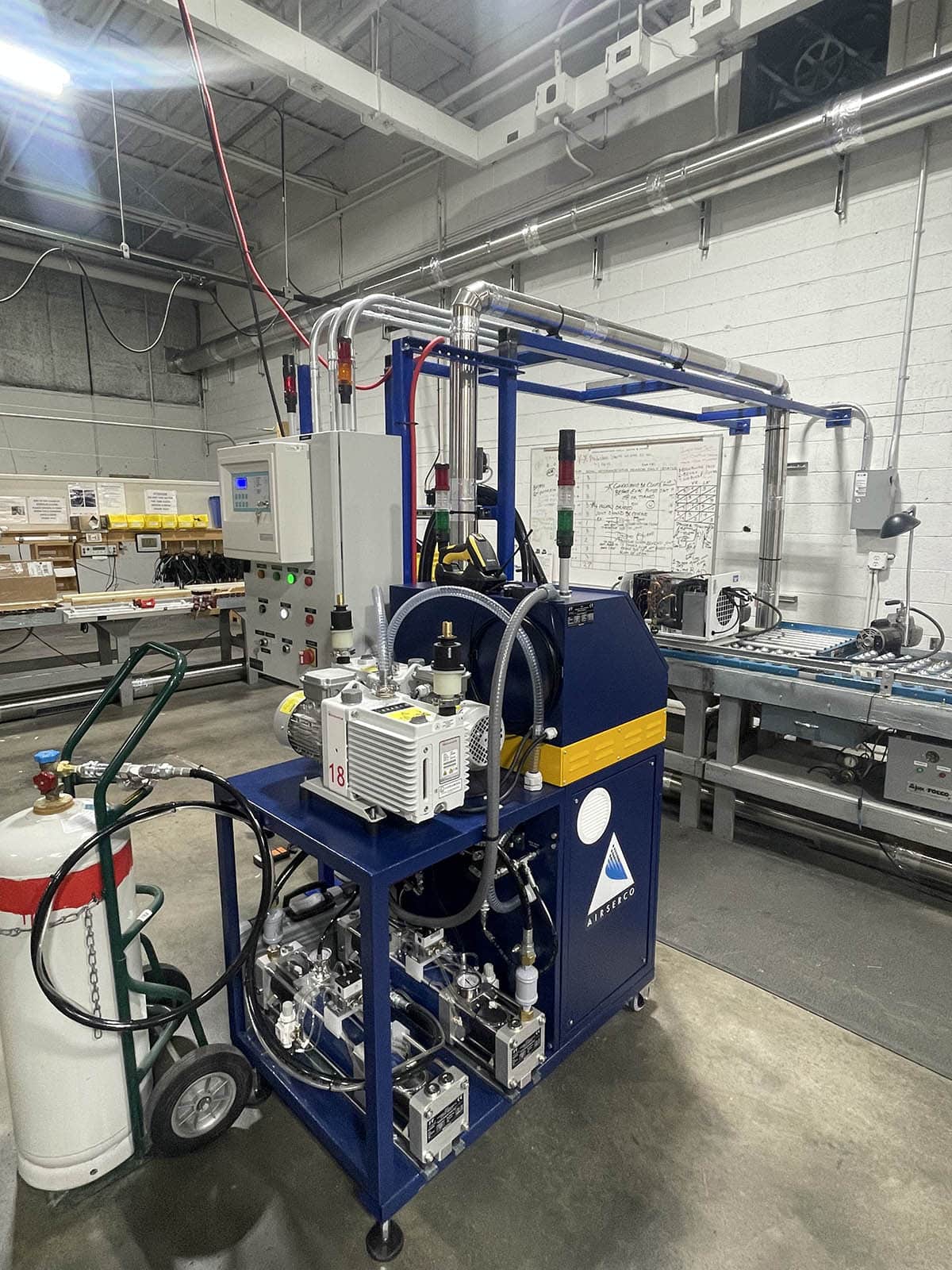
When a vacuum system stalls above the desired ultimate pressure (e.g., stopping at 500 microns when the target is 50), the system has reached an equilibrium where the pumping speed equals the gas load (leaks + outgassing).
In the molecular flow regime, gas molecules no longer behave like a fluid; they move randomly. A leak at this stage is often too small for acoustic detection and too subtle for standard bubble tests, yet it admits enough atmospheric gas to completely derail the evacuation process.
Finding these leaks is a process of elimination. Fixing them requires a material that can seal the leak path immediately without introducing high-vapor-pressure volatile organic compounds (VOCs) that would themselves outgas and ruin the vacuum.
The Engineering Solution: LiquiVac 4036
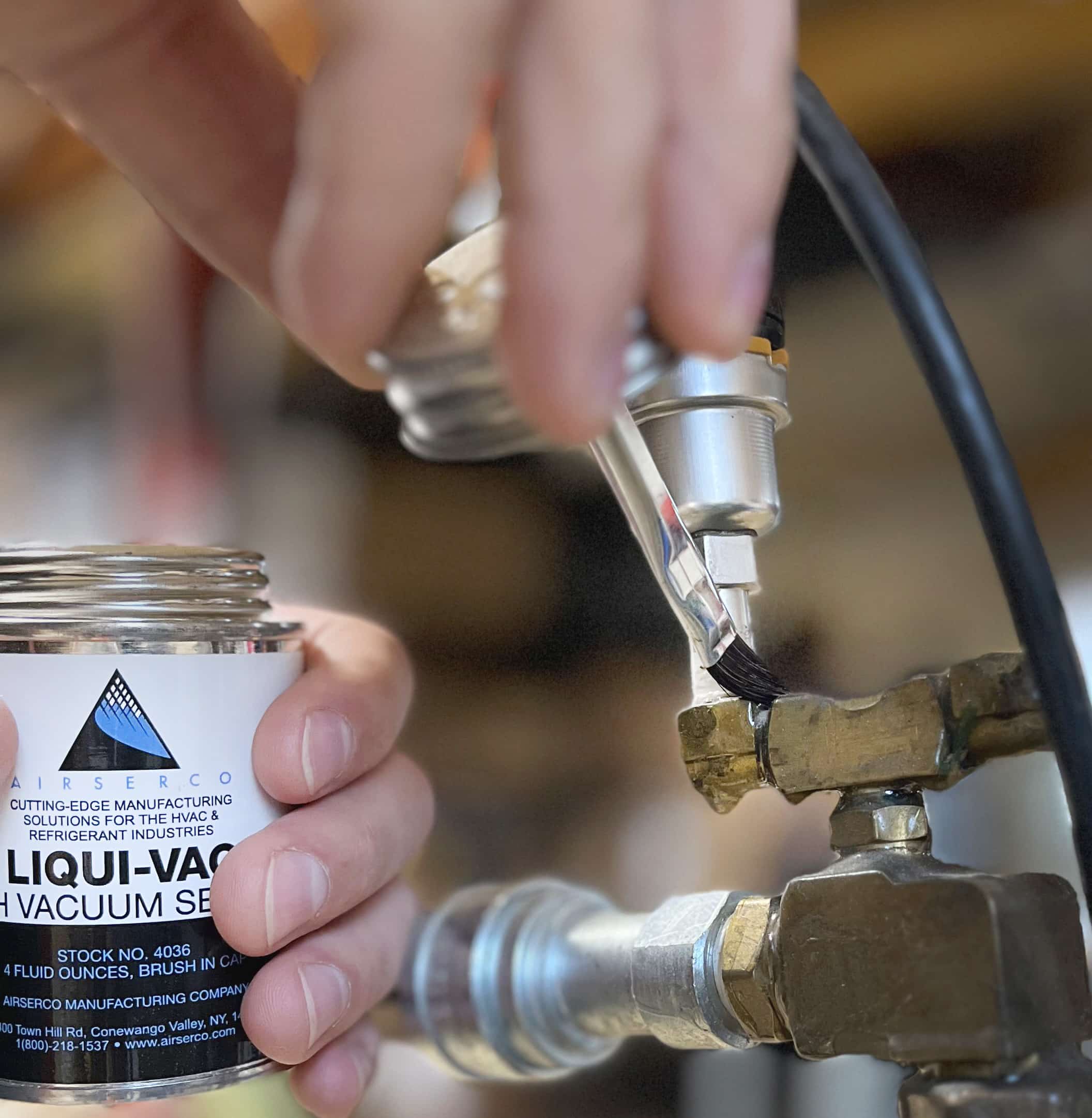
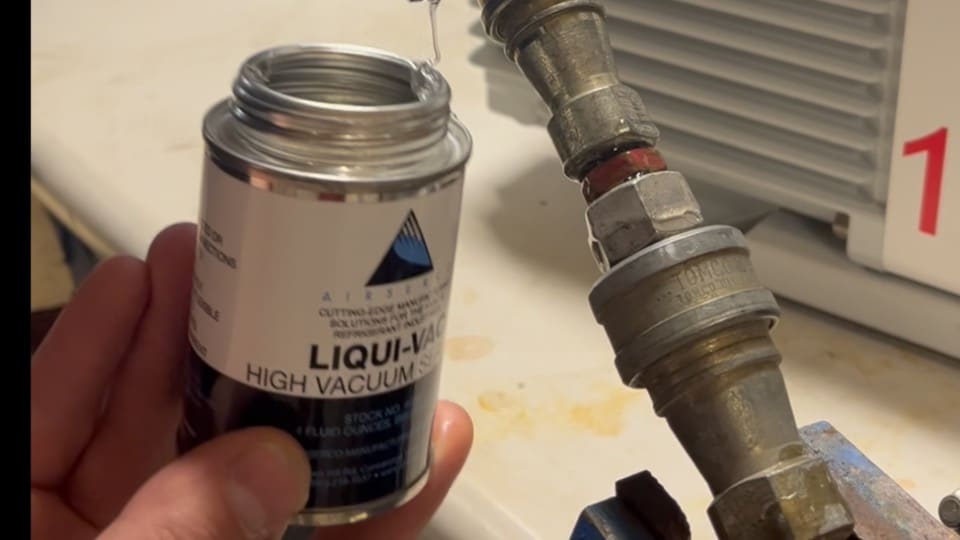
LiquiVac is an engineered liquid sealant designed specifically for the rigorous demands of high-vacuum environments. Unlike standard epoxies or thread lockers, which are designed for permanence and structural rigidity, LiquiVac is formulated for temporary, high-performance sealing.
It serves two primary functions for the engineer:
- Diagnostic Isolation: It allows operators to quickly coat suspect joints. If the vacuum reading drops immediately, the leak is located.
- Process Recovery: It creates a robust patch that allows the evacuation process to finish, saving the batch or test run.
Technical Specifications & Capabilities
- Vacuum Capability: Seals effective down to 1 micron.
- Leak Rate Remediation: Capable of sealing leaks as small as 2 microliters per second.
- Thermal Range: Operates effectively from -100°F to +325°F. This wide delta makes it suitable for cryogenic lines as well as heated discharge lines or autoclave processes.
- Refrigerant Compatibility: Fully compatible with modern A2L and A3 (flammable) refrigerants, ensuring safety in HVACR manufacturing lines.
- Solvent Resistance: Resists degradation from most common industrial solvents, ensuring the seal holds during the evacuation cycle.
- SDS: Download the LiquiVac 4036 Safety Data Sheet.
The “Temporary” Advantage
A common question from purchasing departments is, “Why use a temporary sealant instead of a permanent epoxy?”
In high-value manufacturing, permanence is often a liability.
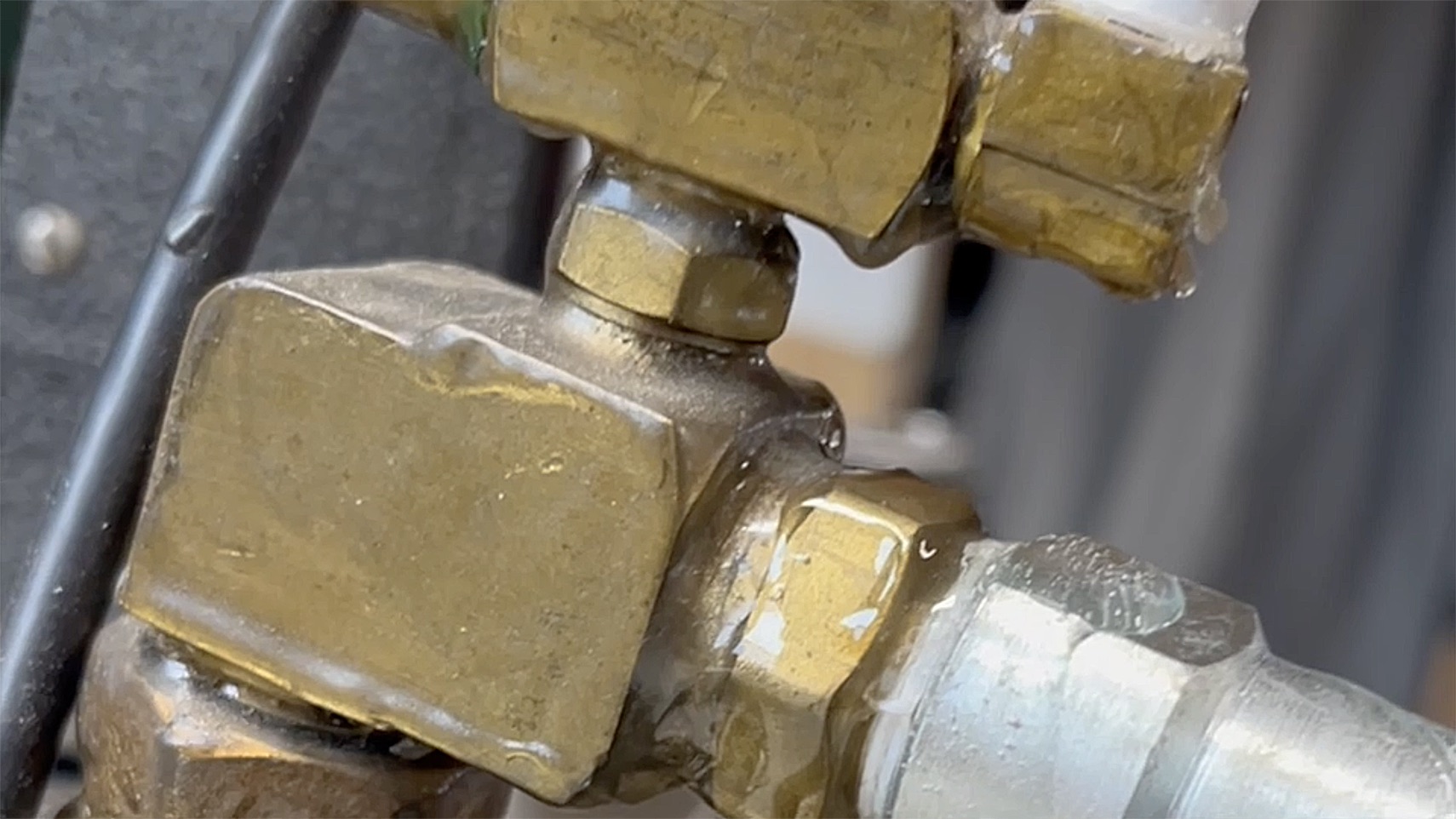
If a threaded connection on a prototype manifold or a production line test fixture leaks, welding it shut or gluing it with epoxy makes future maintenance impossible. LiquiVac sets up quickly to hold the vacuum but remains flexible.
- Non-Destructive: It does not bond metal-to-metal effectively enough to prevent disassembly. When the production run is done, the fitting can be unscrewed, peeled off, and re-taped or re-machined as needed.
- Vibration Resistance: Because it remains flexible, it resists cracking under the vibration of high-CFM vacuum pumps, a common failure point for brittle, hardening sealants.
Strategic Applications in Manufacturing
1. The Production Line “Save”
On an HVAC assembly line, rejecting a unit because it won’t pull a deep vacuum is costly.
Often, the leak is at a temporary service port or a charging adapter. Applying LiquiVac to the threads or the flare face of the service tool allows the evacuation to proceed, verifying that the unit itself is sealed, even if the tool connection was imperfect. This prevents false failures.
2. R&D and Prototyping
When testing new heat exchanger designs or manifold configurations, engineers change connections frequently.
A persistent micro-leak in a test setup can skew data on thermal performance. LiquiVac allows R&D engineers to patch leaks on the fly, gather their data, and disassemble the unit later for analysis without destroying components.
3. Field Diagnostics
For field engineers troubleshooting cascade systems or chillers, isolating a leak is 90% of the battle.
LiquiVac allows for rapid segmentation of the system. By sealing external joints one by one, the engineer can confirm if a leak is external (fixable) or internal (requiring component replacement).
Best Practices for Application
To maximize the effectiveness of LiquiVac, adhere to the following protocol:
- Surface Prep: While LiquiVac is tolerant, wiping the surface with a solvent to remove heavy oil or grease ensures better adhesion.
- Target Areas: Apply to the root of threads, the back of flared connections, and face joints.
- Cure Time: The product is designed for rapid set-up. It does not require a long cure time before pump-down can resume, minimizing downtime.
Next Steps
In the equation of manufacturing efficiency, small leaks equal large losses. LiquiVac 4036 provides Manufacturing Engineers with a reliable, scientifically formulated variable control. It is not just a “glue”; it is a vacuum-rated tool designed to maintain system integrity, protect lead times, and ensure that your equipment reaches its ultimate pressure requirements.
FAQs
Why does my vacuum gauge stall just above the target pressure during evacuation?
A stalled vacuum—such as hovering at 500 microns when your target is 50—means your system has reached an equilibrium where the pumping speed equals the gas load. This is typically caused by a micro-leak or outgassing (a “virtual leak”). In this molecular flow stage, the leak is often too subtle for acoustic or bubble testing but large enough to halt the evacuation process.
Why use a temporary vacuum sealant instead of a permanent epoxy to fix a leak?
In high-value manufacturing and R&D, permanence is a liability. Using standard epoxy or rigid thread lockers makes future maintenance, disassembly, or re-machining impossible. A temporary, vacuum-rated sealant like LiquiVac holds the vacuum while remaining flexible, which allows it to resist pump vibration and lets you easily disassemble the fitting once the production run or testing is complete.
Will a temporary sealant hold up to extreme temperatures and flammable refrigerants?
Yes, an engineered high-vacuum sealant is built for these specific stresses. LiquiVac 4036 is formulated to seal down to 1 micron and operate effectively in extreme thermal ranges from -100°F to +325°F. Furthermore, it is fully compatible with modern A2L and A3 (flammable) refrigerants and resists common industrial solvents.